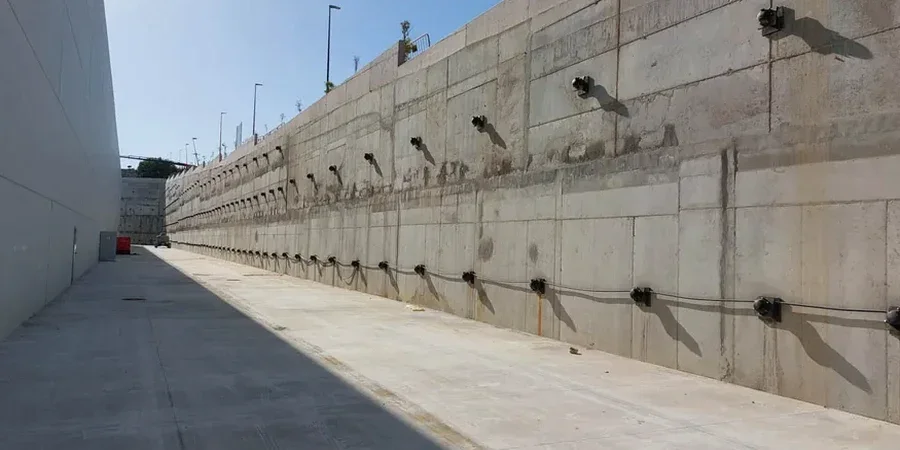
A recent excavation near Commercial Street hit a limestone pinnacle 8 feet below the pavement. The contractor had planned standard deadman anchors, but the buried pinnacle shifted the entire load path. We redesigned the restraint system using a combination of passive rock anchors socketed into the sound Burlington-Keokuk formation and a single active strand anchor on the south wall to manage the eccentric thrust from the adjacent five-story structure. In Springfield, the contact between weathered residuum and intact limestone rarely follows a straight line. A test pit investigation lets us map that contact directly, and when we need continuous profiles without disturbing the sample we often run a CPT test through the overburden clay before selecting the bond length and type.
In Springfield karst, anchor capacity is controlled more by void geometry than by tendon steel. You grout to refusal first, then verify load.
Our approach and scope
Local considerations
Springfield winters fluctuate around freezing, and the freeze-thaw cycles open hairline fractures in weathered limestone that were tight during the summer investigation. A passive anchor grouted in August can lose bond stress by February if water infiltrates those fractures and expands. We compensate by increasing the bonded length in the upper 10 feet of rock when the anchor is installed between October and March. The other risk is hydraulic connectivity: a grout hole intersecting a karst conduit can drain into the James River basin or the Sac River tributaries without ever surfacing at the borehole collar. Monitoring grout take in real time during installation is not optional here—it is the only way to confirm that the anchor bulb is actually where the drawing says it should be.
Explanatory video
Relevant standards
IBC 2021 Section 1810 (Deep Foundations and Anchors), ASCE/SEI 7-22 Minimum Design Loads, Chapter 18, ASTM A416 / A722 for tendon and bar steel, PTI DC35.1 Recommendations for Prestressed Rock and Soil Anchors
Complementary services
Active strand anchor design and proof testing
Full design package including load-deformation analysis, bonded/unbonded length specification, and on-site proof testing to 133% of lock-off load with calibrated hydraulic jacks and digital logging.
Passive rock anchor and soil nail evaluation
Evaluation of fully grouted bar anchors for temporary and permanent retaining systems in residual clay over limestone, with creep testing in cohesive soils per project specifications.
Typical parameters
Common questions
What is the typical cost range for anchor design and testing in Springfield MO?
For a typical commercial excavation requiring 20 to 40 anchors, the engineering design, load testing supervision, and reporting usually falls between US$1,120 and US$3,910 depending on the number of anchor types and the complexity of the karst investigation needed.
How do you handle anchor installation when a karst void is encountered during drilling?
We pause drilling and log the void depth and estimated volume using water loss or air return data, then decide between casing the hole through the void, grouting the void prior to anchor installation, or relocating the anchor position slightly to find competent rock. The decision is made in the field with the geotechnical engineer present.
What is the difference between active and passive anchors for a retaining wall in Missouri?
An active anchor is tensioned to a design lock-off load and actively compresses the wall against the ground before any excavation proceeds. A passive anchor is not tensioned; it only develops resisting force as the wall moves and the ground deforms. In Springfield, where weathered limestone can creep slowly, active anchors give more predictable wall performance for permanent structures.