The geology under Springfield shifts fast once you cross from the limestone bedrock north of I-44 to the deeper residual clays and chert towards the James River. We have pulled Shelby tube samples near the old quarry district on the west side where cohesion held at 1,200 psf, and two miles south near Sequiota Park the same clay lost 40 percent of its strength under saturation. That contrast is exactly why a triaxial test matters here. A standard bearing capacity check or SPT blow count will not tell you how the soil behaves when the water table rises after a wet spring. We run consolidated undrained and unconsolidated undrained triaxial tests at cell pressures matched to your excavation depth, and the friction angles and cohesion intercepts we deliver go straight into slope models and footing calculations that actually reflect the site conditions in Greene County.
A triaxial test on an undisturbed Springfield clay sample will usually give you a friction angle 2 to 4 degrees lower than the USCS estimate, and that difference can be the margin between a stable excavation and a blowout.
Our approach and scope
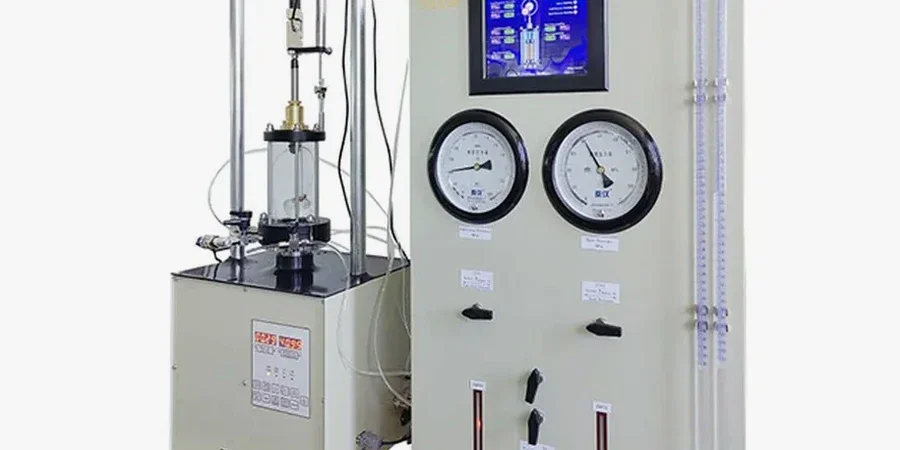
Local considerations
A practical thing we notice in Springfield: many older retaining walls along the creeks, especially near Galloway and the James River greenway, were designed with total stress parameters from unconfined compression tests on dessicated samples. Those samples crumble when you try to trim them, so the lab reports an artificially high unconfined compressive strength. A proper triaxial test on a saturated specimen from the same boring will often show that the effective friction angle drops below 20 degrees when the clay is fully softened. If you are adding a surcharge behind an existing wall or cutting into a slope for a new commercial pad, ignoring that strength loss means you are designing with a phantom safety factor. We run consolidated drained tests with pore pressure monitoring on these borderline materials, and the stress paths usually reveal contractive behavior that peak strength envelopes miss entirely.
Relevant standards
ASTM D4767 – Consolidated Undrained Triaxial Compression Test, ASTM D2850 – Unconsolidated Undrained Triaxial Compression Test, ASTM D7181 – Consolidated Drained Triaxial Compression Test, IBC Chapter 18 – Soils and Foundations, FHWA NHI‑06‑088 – Soils and Foundations Reference Manual
Complementary services
CU and CD triaxial with pore pressure measurement
Consolidated undrained and consolidated drained tests on undisturbed Shelby tube specimens, with electronic pore pressure monitoring and back‑pressure saturation to meet Skempton B‑value requirements. We provide Mohr‑Coulomb envelopes, stress path plots, and drained and undrained strength parameters for slope stability, retaining wall design, and deep excavation analysis.
Unconsolidated undrained (UU) triaxial screening
Quick‑turnaround UU tests for preliminary foundation design, compacted fill verification, and Missouri DOT subgrade modulus checks. We run these at confining pressures matched to the overburden stress at your boring depth and deliver undrained shear strength values within three business days of sample arrival.
Typical parameters
Common questions
How much does a triaxial test cost in Springfield Missouri?
A single triaxial test on an undisturbed Shelby tube specimen typically runs between US$1,650 and US$2,330, depending on whether you need a consolidated undrained test with pore pressure measurement or a simpler unconsolidated undrained run. Multi‑stage tests and consolidated drained programs fall at the higher end of that range because of the longer saturation and shearing time. We quote per specimen, and volume discounts apply when you bundle three or more samples from the same boring program.
What is the difference between a triaxial test and an unconfined compression test?
An unconfined compression test loads the specimen with no lateral confinement, so it only works on cohesive soils that can stand up on their own. A triaxial test applies a controlled cell pressure around the specimen, which lets us measure friction angle and cohesion separately and simulate the stress conditions at the depth where the sample was taken. In Springfield's stiff residual clays, the unconfined test often overestimates strength because the sample is partially dried, while the triaxial test gives you effective stress parameters that account for pore water pressure.
How long does it take to get triaxial test results?
Unconsolidated undrained tests can be reported in three business days after sample arrival. Consolidated undrained tests with full pore pressure measurement take five to seven business days because of the saturation and consolidation stages. Consolidated drained tests run longer, usually seven to ten business days. We can expedite turnaround when the driller is still on site and you need parameters to decide on foundation depth adjustments.
Do you need Shelby tubes for triaxial testing or can you use SPT split spoon samples?
We strongly prefer undisturbed Shelby tube samples for triaxial testing because the specimen needs to retain its in‑situ structure and moisture content. SPT split spoon samples are too disturbed to give reliable effective stress parameters. If the only available samples are from SPT splits, we can still run a remolded triaxial test for preliminary screening, but we flag the results as disturbed and recommend follow‑up sampling with thin‑wall tubes before finalizing foundation design.