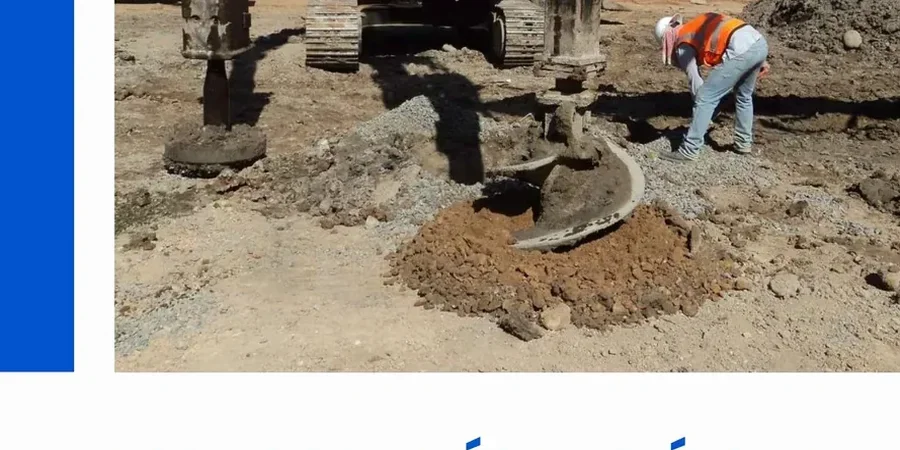
The vibrator probe is the workhorse on most Springfield jobs. A 130 kW hydraulic power pack drives a specially fabricated steel mandrel, typically 18 to 36 inches in diameter, straight into the ground while the hopper feeds clean crushed limestone from local southwestern Missouri quarries. The probe builds the column from the bottom up in controlled lifts, compacting the stone against the surrounding soil with each withdrawal. When the rig shows up on site, the first thing the technician checks is whether the karst limestone is shallow, because Springfield sits squarely on the Springfield Plateau with the Burlington-Keokuk formation rarely deeper than 40 feet. That means every column has to be terminated carefully above the rockhead to avoid punching into solution cavities. The team runs a test pit program beforehand to physically confirm the overburden profile, and then the vibratory probe does the rest, building a stiff drainage path that also densifies the surrounding silty clay.
A properly installed stone column in Springfield's residual clays can triple the composite modulus, turning marginal ground into a buildable platform without overexcavation.
Our approach and scope
Local considerations
Ground conditions change fast when you cross from the northwest side of Springfield, where the clay is thicker and the limestone deeper, to the southeast side around Battlefield Road where pinnacled rock can be just six feet down. The biggest gamble is hitting a solution cavity. If the vibrator punches through the roof of a void, you lose grout pressure instantly and the stone column becomes a conduit into the karst aquifer, which is the same aquifer that feeds Fantastic Caverns just a few miles north. That is an environmental liability no contractor wants. The other failure mode is designing columns too short. Springfield's seasonal moisture fluctuation causes the upper 10 to 15 feet of clay to shrink and swell; a column that does not extend below the active zone will settle differentially and the slab will crack. We run the CPT test on tighter sites where the rig access is limited, because the continuous sleeve friction trace catches the exact depth where the clay transitions to weathered rock, and that is where the column tip belongs.
Relevant standards
ASTM D1586 Standard Test Method for Standard Penetration Test, ASTM D2487 Standard Practice for Classification of Soils, ASCE 7 Minimum Design Loads for Buildings, IBC Section 1803 Geotechnical Investigations
Complementary services
Stone Column Design Package
Deliverables include the column layout plan with center-to-center spacing, the area replacement ratio calculation, the stone gradation specification sourced from local quarries, and the modulus verification protocol using plate load testing. Every design references the SPT or CPT data from the same site so the stress concentration factor stays defensible.
Post-Installation Verification
We run the plate load test directly on top of a completed stone column to confirm the composite modulus matches the design. For larger projects, a grid of three to five columns gets tested and the results are compared against the settlement prediction in the geotechnical report, with signed documentation for the city building department.
Typical parameters
Common questions
How much does a stone column design cost for a Springfield commercial lot?
For a typical commercial building pad in Springfield, the design package including the site investigation, column layout, and QA/QC specification falls between US$1.300 and US$5.590 depending on the number of columns, the depth of treatment, and whether SPT or CPT data is already available. Smaller lots with five to eight columns land at the lower end; larger industrial sites with complex karst conditions run toward the upper end.
How deep do stone columns need to go in Springfield's karst terrain?
The column tip should stop one to two feet above the top of competent limestone, which in Springfield is usually the Burlington-Keokuk formation. The depth varies from as little as 12 feet on the southeast side to over 30 feet in the downtown area. We map the rock surface with borings or CPT soundings first so the column length is never guessed.
Can stone columns prevent differential settlement on Springfield's expansive clays?
Yes, and that is one of the main reasons developers choose them here. The columns extend below the seasonal moisture fluctuation zone, typically 12 to 15 feet deep in Greene County, and the granular column core provides a stiff vertical load path while also draining excess pore pressure. When the grid spacing is designed correctly, the composite system limits total settlement to under half an inch and differential settlement to a fraction of that.