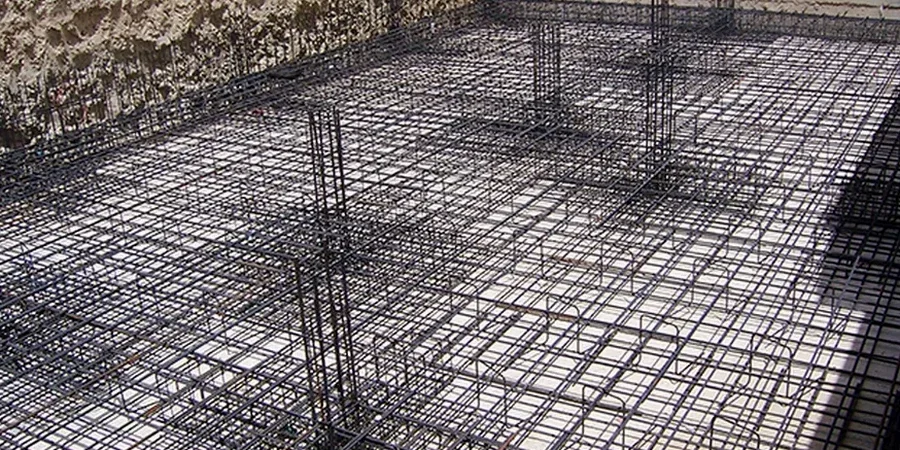
A common mistake we see in Springfield is treating a mat foundation like a thickened slab-on-grade and calling it a day. The truth is that the city sits on the Springfield Plateau, underlain by Mississippian limestone with pockets of residual red clay that can shrink and swell dramatically with seasonal moisture changes. This isn't textbook soil; it demands a raft design that accounts for differential movement. We routinely integrate site-specific data from test pits to map the depth to bedrock across the building footprint, which often varies more than owners expect. Combining that with a thorough grain size analysis gives us the fines content needed to predict volume change potential under the mat. The result is a foundation system sized for the actual subgrade, not an assumption.
A mat foundation in Springfield's karst terrain works as a rigid plate: it bridges soft spots, but only if the design anticipates where those spots are.
Our approach and scope
Local considerations
In Springfield, the biggest trap isn't the clay itself, it's the old neighborhood fill. Areas around Jordan Creek and sections of midtown were leveled with ash, brickbats, and debris generations ago, and this material decomposes unevenly. I've seen a mat foundation perform beautifully over natural soil but crack over a pocket of undocumented fill because the modulus contrast wasn't picked up in the exploration phase. Another risk is sinkhole activity; the Missouri Geological Survey maps numerous karst features across the county, and a mat has to be solid enough to span a potential collapse. We always recommend a closely-spaced boring program and, for critical structures, a cross-hole seismic survey to verify rock integrity below the mat footprint. Skipping these steps saves a few thousand dollars upfront but can lead to a foundation that tilts and requires expensive underpinning later.
Relevant standards
ASCE 7-22 Minimum Design Loads for Buildings, IBC 2021 Chapter 18 Soils and Foundations, ACI 318-19 Building Code Requirements for Structural Concrete, ASTM D2487 Standard Practice for Classification of Soils
Complementary services
Subgrade Reaction Modulus Testing
Field plate load tests per ASTM D1195 on prepared subgrade to determine the modulus of subgrade reaction (k_s) used directly in the mat foundation design model.
Karst Hazard Assessment
Review of geological mapping, coupled with electrical resistivity profiling, to locate potential voids or solution channels in the Burlington-Keokuk limestone beneath the proposed mat.
Settlement Analysis
Consolidation testing on Shelby tube samples of residual clay to calculate total and differential settlement under the mat's bearing pressure, with time-rate predictions.
Typical parameters
Common questions
What is the typical cost range for a raft foundation design in Springfield?
For a residential or light commercial structure, the geotechnical investigation and foundation design engineering typically run between US$1,190 and US$4,330, depending on the building footprint, number of borings required, and whether karst investigations are needed.
When is a mat foundation better than isolated footings here?
A mat becomes the better choice when the allowable bearing pressure is low (under 2,000 psf, common in our residual clays) or when you have erratic bedrock depth. It reduces differential settlement and can eliminate the need for deep foundations if designed with the correct rigidity.
How deep do you explore for a mat foundation in Greene County?
We typically advance borings to a depth of at least twice the mat width below the bearing elevation, or until competent limestone is encountered. In Springfield's karst areas, we often extend exploration deeper to rule out voids that could affect the foundation long-term.
Do you handle the structural engineering for the mat as well?
Our scope covers the geotechnical parameters: bearing capacity, modulus of subgrade reaction, and settlement. We work alongside your structural engineer, providing the soil-structure interaction values they need to complete the reinforcement design per ACI 318.