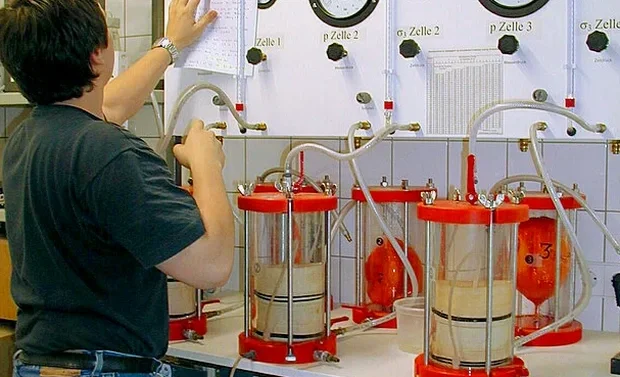
Contractors breaking ground near the James River Freeway know the challenge: Springfield’s geology swings from residual cherty clay to pockets of alluvial silt within half a mile. I’ve seen subgrade failures on US 60 widening projects where the design assumed a uniform CBR of 8, but the actual values ranged from 3 to 15 across the site. That variance, if unmeasured, translates directly into under-designed asphalt sections that rut after two freeze-thaw cycles. Our laboratory CBR test provides the measured soaked and unsoaked bearing ratios that Missouri DOT and consulting engineers rely on to calibrate pavement thickness. Because the CBR value is not a soil property—it’s an empirical index—the sample preparation and compaction energy must mirror the field density specification exactly, which is where many generic labs in the Ozarks fall short. We run the full ASTM D1883 procedure on remolded specimens compacted at optimum moisture content per the project’s Proctor curve, then soak them for 96 hours to simulate the worst-case saturation the Springfield subgrade will see after a wet winter like the one that flooded the Wilson’s Creek basin in 2017.
A soaked CBR of 3 versus a soaked CBR of 8 can double the required asphalt thickness—the difference between a 6-inch and a 12-inch section on the same traffic loading.
Our approach and scope
Local considerations
Springfield sits on the Springfield Plateau, where the bedrock is Mississippian limestone mantled by a thin, highly variable residuum. The chert content in the residual soil—sometimes 30% by weight—causes the CBR to jump erratically depending on whether the tested specimen captures a chert fragment or a pocket of lean clay. Testing only at unsoaked conditions masks the real risk: a soil that posts a CBR of 12 at field moisture can collapse to a CBR of 4 after saturation, which is exactly what happened under the parking lot at the Battlefield Mall expansion in the late 1990s. We’ve also seen contractors skip the moisture-density relationship and run the CBR on specimens compacted at arbitrary water contents, producing values that bear no relation to the as-compacted subgrade. The IBC references ASCE 7 for foundation design, but for pavement structures in Greene County, the governing document is the Missouri DOT Engineering Policy Guide Section 201, which mandates soaked CBR testing for all flexible pavement designs on public roadways.
Relevant standards
ASTM D1883-21, ASTM D698 / D1557, MoDOT Engineering Policy Guide Section 201
Complementary services
CBR Test Package for Pavement Design
Includes moisture-density relationship (Proctor), soaked CBR at three compaction levels, swell measurement during soaking, and a summary table with the design CBR value at 95% of maximum dry density.
Subgrade Characterization Suite
Combines laboratory CBR with grain size distribution and Atterberg limits to classify the soil per ASTM D2487, providing the AASHTO soil group and the resilient modulus correlation for MEPDG inputs.
Typical parameters
Common questions
What is the typical turnaround time for a laboratory CBR test in Springfield?
After we receive the bulk sample, the Proctor compaction test takes two days, specimen preparation and compaction takes one day, and the four-day soaking period begins once the specimen is assembled with the surcharge weights. Penetration testing and the report are completed on day seven. Expect a final signed report within eight business days for a standard package.
How much does a laboratory CBR test cost for a project in Greene County?
A single-point CBR test (one compaction effort, soaked) typically ranges from US$120 to US$210, depending on whether it’s paired with a Proctor curve and Atterberg limits. A three-point CBR series for a design curve costs more but gives the engineer the full moisture-density-strength relationship.
Do you need the field density target from the contractor before running the CBR test?
Yes—the CBR specimen must be compacted to the specified percentage of maximum dry density (usually 95% or 98% of Standard Proctor) and at the target moisture content range. Without the project’s compaction specification, the test result won’t represent the as-built condition.
What’s the difference between soaked and unsoaked CBR, and which one does MoDOT require?
Unsoaked CBR measures the soil’s strength at the compaction moisture content, which is optimistic for a climate like southwest Missouri’s. Soaked CBR simulates long-term saturation after the water table rises or precipitation infiltrates the pavement structure. MoDOT requires the soaked value for design because Springfield’s average annual rainfall of 45 inches guarantees the subgrade will see saturated conditions at some point during the pavement’s service life.
Can you test aggregate base course with the CBR method, or is it only for soil?
The CBR test was originally developed by the California Division of Highways for evaluating both subgrade soils and granular base materials. We test crushed limestone base from local quarries like the Willard quarry using the same ASTM D1883 procedure, but the compaction energy and gradation must match the job mix formula. For aggregate with particles larger than 3/4 inch, we scalped the oversize fraction and apply a correction per ASTM D4718. More info.