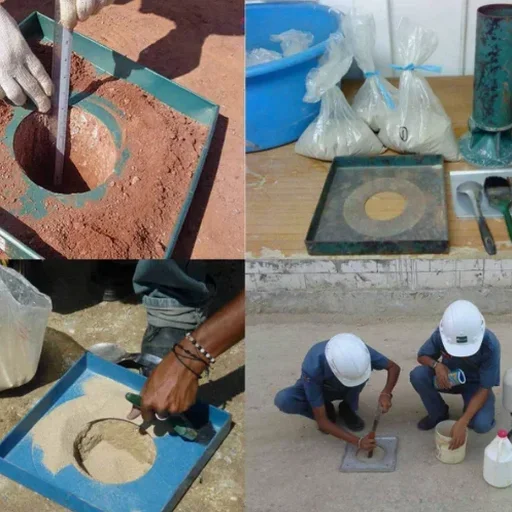
Springfield sits on a geological patchwork of Mississippian limestone residuum, alluvial deposits along the James River, and substantial areas of fill from decades of development on the Springfield Plateau. When the IBC mandates compaction verification under Chapter 17, the sand cone method per ASTM D1556 remains the most direct way to confirm that a contractor has actually achieved the specified relative compaction — not just at the surface, but at depth. In our experience across Greene County, the difference between a passing nuclear gauge reading and a failing sand cone result often comes down to the rock content in the local red clay. We run the test pits first to classify the material, then tie grain size and Atterberg limits to the density data so the earthwork spec isn't just a number — it has geological context.
A passing compaction curve in the lab means nothing if the field density test shows 88 percent where 95 was specified.
Our approach and scope
Local considerations
The most common mistake we see on Springfield earthwork jobs is running sand cone tests without verifying the Proctor reference curve on the actual fill material being placed — particularly when the borrow source changes mid-project. One contractor on a school expansion on the north side brought in what looked like the same red clay from a different pit; the optimum moisture shifted by four percentage points, and the first lift was compacted on the dry side of the curve. It passed the nuclear gauge but failed every sand cone check. The lift had to be scarified, re-wetted, and re-compacted, delaying the slab pour by eight days. Moisture control during compaction is a bigger variable here than people realize, especially in late summer when the clay crusts over fast. We also see problems around stormwater detention structures where the engineer specifies density for the berm but the contractor never assigns a technician to test it — then the first heavy rain reveals the settlement. For any fill that will support a structure or retain water, skipping the field density test is a gamble the owner loses.
Relevant standards
ASTM D1556 – Standard Test Method for Density and Unit Weight of Soil in Place by Sand-Cone Method, ASTM D698 – Standard Test Methods for Laboratory Compaction Characteristics of Soil Using Standard Effort, ASTM D1557 – Standard Test Methods for Laboratory Compaction Characteristics of Soil Using Modified Effort, IBC Chapter 17 – Special Inspections and Tests, AASHTO T 191 – Density of Soil In-Place by the Sand-Cone Method
Complementary services
Compaction verification per ASTM D1556
On-site sand cone testing for structural fill, utility trench backfill, and pavement subgrade. We provide real-time pass/fail results with moisture correction.
Proctor compaction testing (ASTM D698 / D1557)
Laboratory determination of moisture-density relationships on the actual fill material from your Springfield site, so the field density target has a valid reference.
Nuclear gauge correlation studies
Side-by-side sand cone and nuclear gauge tests to develop a site-specific calibration curve, often required by the project geotechnical engineer when gauge results are disputed.
Special inspection reporting
IBC-compliant daily reports with location plans, density values, and percent compaction for submission to the building official and the design team.
Typical parameters
Common questions
How much does a field density test (sand cone method) cost in Springfield MO?
A single sand cone density test in the Springfield area generally ranges from US$90 to US$160 per test, depending on mobilization distance, number of tests per visit, and whether laboratory Proctor data is already available. For larger earthwork projects requiring daily technician presence, we structure rates by the half-day or full-day to keep per-test costs on the lower end of that range.
How many sand cone tests does the IBC require on my Springfield project?
IBC Chapter 17 specifies a minimum frequency of one field density test per 2,500 square feet of each lift of compacted fill, though the geotechnical engineer of record may increase that frequency based on site variability or the criticality of the structure. For utility trench backfill, we typically test every 50 linear feet per lift in road crossings and every 100 feet in open areas.
Can the sand cone method be used in gravelly soils common around Springfield?
ASTM D1556 is suitable for soils with particle sizes up to roughly 1.5 inches. In the cherty gravel lenses that appear in the Springfield plateau residuum, we often need to excavate a larger test hole and use a replacement method calibration. If the gravel content exceeds about 30 percent, we may recommend a large-scale density test or a technique like the rubber balloon method to avoid errors from sand entering voids between cobbles.
What is the difference between standard and modified Proctor for compaction specs in Missouri?
Standard Proctor (ASTM D698, 12,400 ft-lbf/ft³) is the typical reference for most building pads and residential subdivisions in the Springfield area. Modified Proctor (ASTM D1557, 56,000 ft-lbf/ft³) is occasionally specified for heavy industrial floors, airport pavements, or DOT projects. The same sand cone field density test applies to both — the difference is the laboratory compaction curve against which the field result is compared.