The vibrator is a 130 kW electric unit with a 12-inch diameter probe, operating at 30 Hz with water flush. We set it up on a crawler crane for mobility across the clay-rich residuum common around Springfield. The probe penetrates under its own weight plus vibration, creating a column of densified material from the bottom up. Each insertion point follows a triangular grid pattern calculated from grain size distribution and target relative density. In Springfield, we typically aim for 70% relative density in the upper 20 feet. The water jets help the probe advance through sticky chert-laden soil profiles that would stall a dry bottom-feed system. We handle the whole design sequence: site investigation, CPT correlation, energy calibration, and compaction verification.
In Springfield's cherty residuum, vibrocompaction is not about raw vibration—it is about displacing and rearranging the coarse fraction until it interlocks.
Our approach and scope
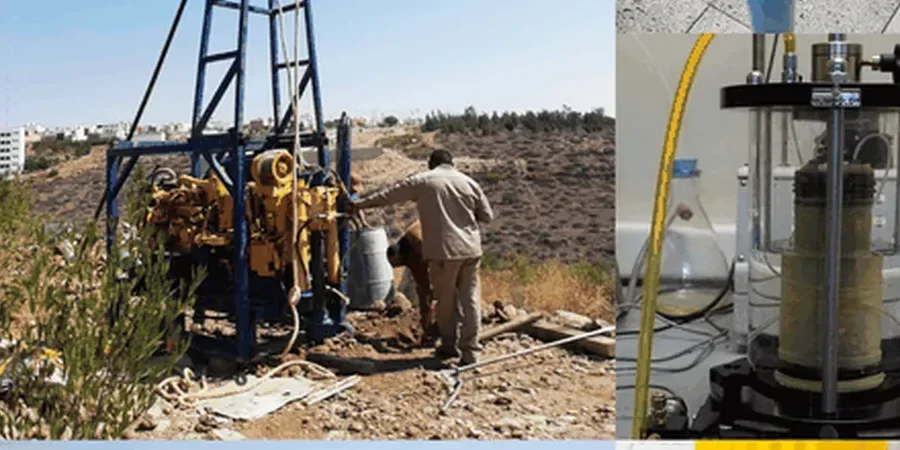
Local considerations
Springfield sits on the Springfield Plateau, underlain by Mississippian limestone with a mantle of residual clay and chert. The chert content is high—often 40% by volume—and the clay matrix is stiff but collapsible when wetted under load. Loose zones exist where solution cavities in the bedrock have allowed overlying soil to ravel downward over geologic time. The New Madrid Seismic Zone lies 150 miles east, but it still influences our design ground motions here. We use IBC Site Class D profiles for most of Greene County. If you skip compaction in a loose cherty clay, you get differential settlement after the first wet season—we have seen 4 inches of movement in less than a year. For sites near the James River, we also check liquefaction potential in the alluvial sands, applying the simplified procedure from Seed & Idriss (1971) as referenced in ASCE 7-22. A well-designed vibrocompaction grid cuts that risk to near zero.
Explanatory video
Relevant standards
ASTM D1586 – Standard Test Method for Standard Penetration Test (SPT) and Split-Barrel Sampling of Soils, ASTM D2487 – Standard Practice for Classification of Soils for Engineering Purposes (Unified Soil Classification System), ASCE 7-22 – Minimum Design Loads and Associated Criteria for Buildings and Other Structures, IBC 2021 – International Building Code, Section 1803 Geotechnical Investigations
Complementary services
Grid Design & Energy Calibration
We determine probe spacing, frequency, and duration per point using CPT data and grain size curves. Energy is calibrated to achieve target density without over-compacting and wasting fuel.
Pre- and Post-Compaction Testing
We run CPT soundings before and after treatment, comparing cone resistance profiles. SPT checks at selected locations verify the correlation. We issue a signed density achievement report.
Karst-Aware Layout Planning
In Springfield's limestone terrain, we adjust the grid to avoid known sinkhole zones and solution-widened joints, using resistivity data to map subsurface anomalies before probe insertion.
Typical parameters
Common questions
What does vibrocompaction design cost for a typical Springfield site?
Design fees run between US$1,660 and US$4,490 depending on the treated area and the number of CPT verification points. A half-acre site with pre- and post-CPT typically falls near the middle of that range.
Can vibrocompaction work in Springfield's clay soils?
Only if the clay is mixed with enough granular material. Pure fat clay does not densify under vibration. We require less than 20% passing the #200 sieve. If the chert and sand fraction dominates, it works well. If not, we recommend stone columns instead.
How do you verify the compaction was successful?
We compare CPT cone resistance before and after treatment. An increase of 40% or more in tip resistance indicates adequate densification. We also run SPT checks per ASTM D1586 at 10% of the probe locations to confirm the CPT data. More info.