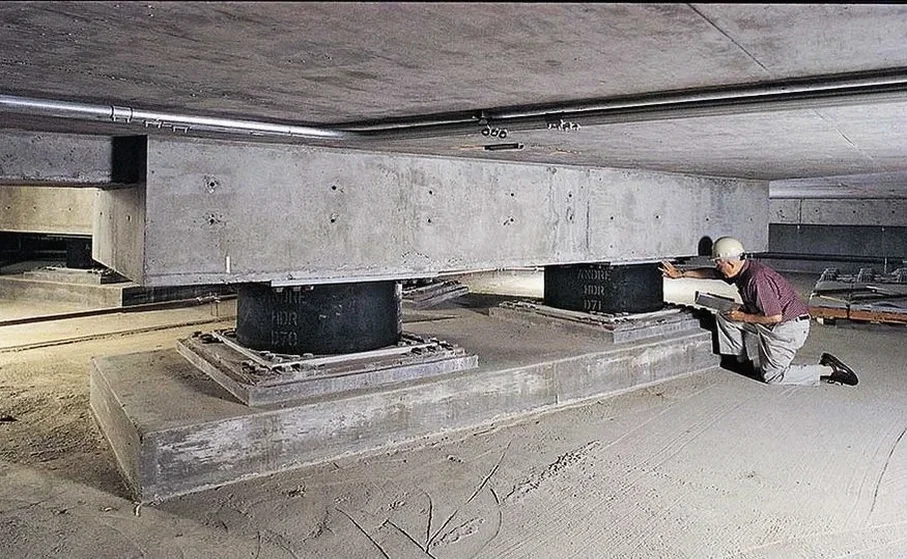
Springfield sits roughly 170 miles from the New Madrid fault system, which in 1811-1812 produced three of the largest earthquakes ever recorded in the continental United States. The USGS estimates a 25-40% probability of a magnitude 6.0 or greater event in the next 50 years, a statistic that directly shapes how we approach base isolation seismic design for hospitals, emergency response centers, and essential facilities across Greene County. Unlike conventional fixed-base construction, which amplifies ground motion into the structure, seismic isolation decouples the building from the shaking soil through specially engineered bearings. When we design for Springfield's specific soil profile—often interbedded limestone and residual clay with variable stiffness—the isolation period must be tuned to move the structure's fundamental frequency well below the dominant site frequencies. This requires integrating subsurface data from a CPT test with the dynamic amplification characteristics of the local soil column.
In the New Madrid zone, base isolation must account for long-period energy and site amplification from karst geology—standard West Coast assumptions don't translate here.
Our approach and scope
Local considerations
Springfield's expansion since the 1970s pushed development onto residual clay formations overlying the Springfield Plateau aquifer, where differential weathering of the Mississippian limestone creates a highly irregular bedrock surface. This irregularity means adjacent borings can show 20 feet of rock elevation difference within 50 horizontal feet. For a base-isolated building, that kind of subsurface variability introduces torsional response if the isolators sit on footings with dissimilar stiffnesses. We address this by requiring closely spaced borings around the isolation plane footprint and cross-checking the dynamic soil properties with liquefaction analysis even when the water table is deep, because the New Madrid source mechanism can generate pore pressure buildup in silty interbeds that conventional logic would overlook. The Uniform Building Code's 1997 adoption of near-source factors was a direct response to the Northridge and Kobe events, but Springfield's risk profile relates more to the 1895 Charleston-style intraplate earthquake—moderate magnitude, large felt area, and long-period shaking that base isolation is specifically designed to mitigate.
Relevant standards
ASCE/SEI 7-22 Minimum Design Loads and Associated Criteria for Buildings and Other Structures, Chapter 17: Seismic Design Requirements for Seismically Isolated Structures, 2024 International Building Code (IBC), Section 1705 and ASCE 7-22 by reference, ASTM E2203 Standard Specification for Dense Thermoplastic Elastomers Used in Compression Seals, Gaskets, Setting Blocks, Spacers and Accessories, AASHTO Guide Specifications for Seismic Isolation Design, 4th Edition (for bridges where applicable)
Complementary services
Isolation System Design & Modeling
Nonlinear time-history analysis with isolator hysteretic models calibrated to prototype test data. We run 11 ground motion pairs per ASCE 7-22 Section 17.3, scaled to match the site-specific response spectrum including New Madrid long-period energy content.
Geotechnical Interface & Soil-Structure Interaction
Characterization of the founding stratum beneath the isolation plane using shear wave velocity profiles, cyclic triaxial data, and settlement analysis under sustained eccentric loading. We document the bearing capacity and rotational stiffness for the isolator pedestals.
Peer Review & Testing Protocol Support
Development of isolator prototype and production test specifications per ASCE 7-22 Section 17.8, including property modification factors (λ) and aging/scragging acceptance criteria. We represent the owner during the design review panel process.
Typical parameters
Common questions
What is the cost range for base isolation design on a new building project in Springfield?
For a mid-rise essential facility (30,000–60,000 sq ft footprint), the engineering design fee for the isolation system typically falls between US$4,040 and US$7,500, depending on the complexity of the nonlinear analysis and the number of ground motion pairs required by the peer review panel. This does not include the isolator hardware procurement, which is a separate manufacturer cost.
How does the New Madrid seismic source affect the isolation design compared to a West Coast project?
New Madrid ground motions contain significant energy at periods of 1.0 to 2.0 seconds because of the deep Mississippi Embayment sediments. This is a critical difference—West Coast crustal events peak at shorter periods. For Springfield, we select and scale ground motion records that match the NGA-East attenuation models, not just the crustal NGA-West2 database, to ensure the isolation system's long-period displacement capacity is not underestimated.
Can existing buildings in Springfield be retrofitted with base isolation?
Yes, though it is more common for high-value essential facilities. The process involves temporarily supporting the structure on jacking columns, cutting the existing columns or walls at the isolation plane, and inserting the bearings. The main constraint in Springfield is the variable bedrock depth—we often need to underpin portions of the existing foundation to create a rigid diaphragm below the isolators, which requires careful coordination with the geotechnical investigation data.
What laboratory tests are required for the isolation bearings before installation?
ASCE 7-22 Section 17.8 mandates prototype testing of at least two full-scale isolators per type. The test program includes three fully reversed cycles at each amplitude (0.25D, 0.5D, 1.0D, 1.0MCE, where D is design displacement), plus a 20-cycle test at 1.0D to assess scragging effects. Production testing of every isolator follows the prototype qualification, with property verification at three displacement levels.